
The Chernobyl nuclear power plant accident occurred on April 26, 1986. It was the largest nuclear energy disaster in history. The explosion took place in the fourth block of the Chernobyl power plant , located only 120 km from the capital of Ukraine – Kiev, close to the border with Belarus.
Chernobyl power plant was at that time one of the largest in the world. It was dedicated to a strategic military program for the Soviet army. The actual crash happened due to a coincidence of several factors. Beside the fact that the reactor did not have an updated security system, it had a low level of automation. On the fatal night of April 26, there was an experiment going on, which should have tested the inertial range of the turbo-generator unit. Overheating fuel caused the destruction of the generator’s surface.
At 1:24 AM local time, 40-60 seconds after commencing the experiment, two large explosions took place. According to some accident investigators, taking off all the absorbing sticks from the active zone of the reactor, together with the reactor’s growing power capacity, the crash was unavoidable. It was recorded that safety systems were shut off or even out of service at the time of the initial explosion and the explosion of steam and hydrogen blew the 1200 ton cover of the reactor and destroyed the roof. After a few seconds there came the second explosion. According to several independent studies, while the first explosion was normal – chemical, the second explosion with the burning of the prompt neutrons, it had characteristics of a nuclear explosion with a yield of 0.3 kilotons (equal to around 300 tons of TNT). According to witnesses the first explosion was followed by a red blaze and the second explosion had a light-blue blaze, after which a mushroom cloud rose above the reactor.
The nuclear disaster was also a coincidence and the reactor should have been shut down before the experiment could begin. However, this was postponed by nine hours because of the forthcoming May 1 celebrations and the electricity needed to fulfill the production plan. This delay meant that the experiment had to be managed by a different shift than the one which prepared it. The night shift conducting the experiment comprised fewer experienced operators.

Der Unfall im Atomkraftwerk Tschernobyl ereignete sich am 26.4.1986. Er gilt als die größte Kernkraftkatastrophe in der Geschichte. Die Explosion ereignete sich im vierten Block des Atomkraftwerks in Tschernobyl, das sich nur 120 km vor der ukrainischen Hauptstadt Kiew, nahe der Grenze zu Weißrussland, befindet.
Das Atomkraftwerk Tschernobyl war damals eines der größten auf der Welt. Es gehörte zu einem strategischen Militärprogramm der sowjetischen Armee. Der eigentliche Unfall ereignete sich aufgrund eines Zusammenspiels von mehreren Faktoren. Neben der Tatsache, dass das Sicherheitssystem des Reaktors veraltet war, war auch die Automatisierungstechnik auf einem geringen Level. In der verhängnisvollen Nacht des 26. April führte man im Kraftwerk ein Experiment durch, bei dem der untätige Bereich der Anlage des Turbo-Generators getestet werden sollte. Überhitzender Kraftstoff verursachte die Zerstörung der Generatoroberfläche.
Um 1:24 örtlicher Zeit fanden zwei Explosionen statt (ungefähr 40 – 60 Sekunden vor dem Beginn des Experiments, das das Unglück auslöste). Laut einigen Ermittlern der Katastrophe nach dem Entfernen gabe es an einem bestimmten Zeitpunkt keine Möglichkeit mehr, den Unfall zu verhindern. Sicherheitssysteme wurden ausgeschaltet, waren sogar außer Betrieb. Es folgte eine erste Explosion von Dampf und Wasserstoff. Diese stoß die 1200 Tonnen schwere Betonplatte des Reaktors nach oben und beschädigte das Dach. Nach ein paar Sekunden fand die zweite Explosion statt. Nach mehreren unabhängigen Studien sollten die erste Explosion klassisch sein – chemische, aber die zweite – nach der Verbrennung der prompten Neutronen – hatte einen Charakter einer nuklearen Explosion mit einer Stärke von 0,3 Kilotonnen (als würden 300 Tonnen TNT explodieren). Laut einigen Augenzeugen hatte die erste Explosion einen roten Schein und die andere blauweiß, nach dieser stieg ein Atompilz über dem Kraftwerk empor.
Die Untersuchung der Reaktorkatastrophe von Tschernobyl wurde mit dem Urteil abgeschlossen, dass das Personal die Sicherheitsbeschränkungen und Vorschriften nicht eingehalten habe. Der Nuklearunfall im Kernkraftwerk V.I. Lenin war nur der Auslöser dafür, dass nicht nur die Sicherheitsparameter der sowjetischen Kraftwerke neu geschrieben werden mussten, sondern auch die Geschichte der Menschheit. Aus dem zerstörten und durchgeglühten Reaktor 4 des Kernkraftwerks Tschernobyl begann die Radioaktivität zu entweichen, deren Ausmaß war eine massive radioaktive Kontamination der unmittelbaren und später entfernten Umgebung.
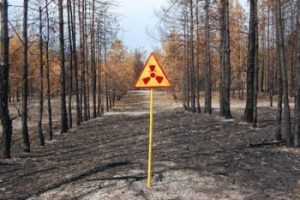
 Pripyat was once a model city of the Soviet government and was erected in 1970 for the workers of the nuclear power plant, situated just three kilometers away. The average age of the city inhabitants was, by the time of the accident only 25 years old. Pripyat had all the luxuries of a modern city – a railway station, port, hospital and a fairground.
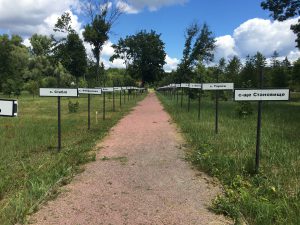
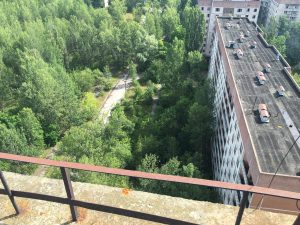 Pripyat is now a city of ghosts and despite nobody living there, it has its own grace and atmosphere. Pripyat did not end like the nearby villages which were buried under the ground by bulldozers. The villages are commemorated only by boards on the road with their names and a village map. Pripyat, as well as the whole 30-kilometer restricted zone is guarded by the Police and Army. Despite this non-stop duty, it did not prevent robbery and plunder, mostly in 1991 after the Soviet Union dissolution when the Chernobyl zone was unwatched. The whole city of Pripyat is plundered and there isn’t a single flat that has not been visited by thieves, taking away all precious items to be found. A military factory (named Jupiter) had been operating in the city until 1997; today it is even more plundered and destroyed than the majority of flats or schools in the city. The city is full of contemporary (that is 1980s) writings, signs, books or pictures, mostly with Lenin motives. Lenin’s statements and portraits are virtually everywhere – in the Palace of Culture, in the hotel, the hospital, at the police station, as well as in the schools and kindergarten. The walk around the city is like a trip back to the past, the only difference is that there’s not a single soul around, not even birds in the sky! One can only imagine the whole picture of the era when the city was booming. The whole city was erected on a green field soon after the nuclear power plant was built. Everything is made out of concrete and the houses look the same as in any other city of the Soviet origin. Some of these buildings have been overgrown with trees and are barely visible from the road. Chernobyl is a vital example of how Mother Nature can cope with the work of Man. In just over two decades only ruins remain from the city. There is no other such place in the world.
 The facts divide upon the number of victims of the Chernobyl crash. Of course , the direct victims were mostly the plant workers as well as the firemen, who received deadly doses of radiation. Most of the direct victims are buried at the Mitino cemetery in Moscow. Each body is sealed in concrete coffin, because of its high radiation.
 stigation of Chernobyl disaster was officially closed with a result that the personnel of the power plant did not follow the necessary safety regulations. Lenin Nuclear Power Plant was just the beginning of an aftermath that re-wrote not just the safety rules in nuclear energy, but also the history of mankind. Radioactivity started to radiate out of the destroyed and burning fourth reactor of Chernobyl power plant, which contaminated both the near and far environment.